
Ref : 0628
An interesting and very good violin of
Unknown Origin
Probably Viennese
Circa 1880
This violin has no identifiers inside or outside as to maker or origin. After physically examining it, neither Jason Price (New York) nor Sean Bishop (London) could give a definite indication of its origin. However, the London-based authority, Florian Leonhard, felt that the instrument very likely is of Viennese origin. My own view is that it is a late 19th century copy of an instrument by Giovanni Gabrielli, but at this time the maker remains unknown.This violin has impressive properties that set it aside essentially as a solo instrument. The tone is unusually powerful with penetration and projection, yet allows for subtle tonal colour gradations. It is highly responsive.
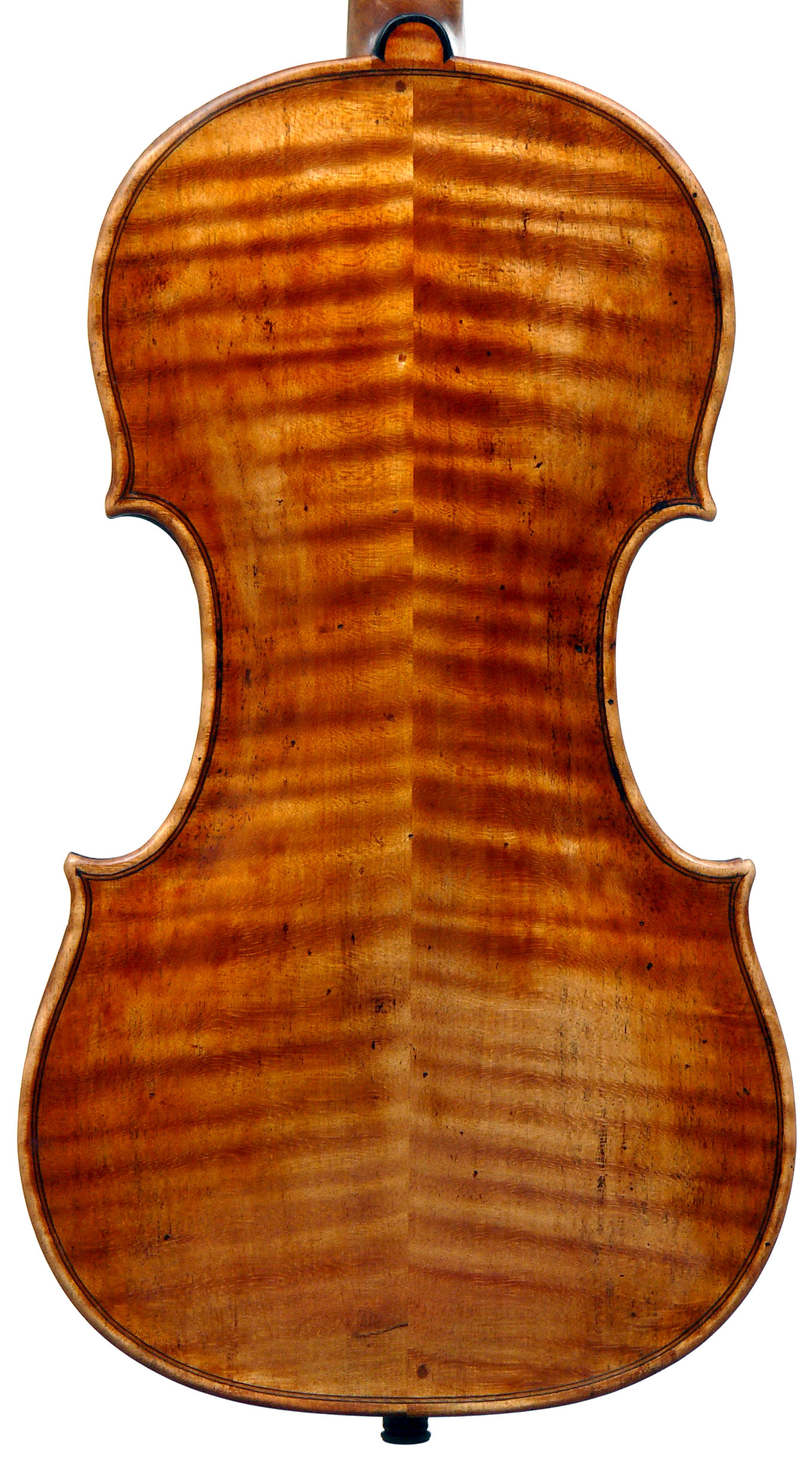
In spite of the neck graft on this violin, it is not as old as one might think - a view shared by all experts who have looked at it. There are very few signs of aging and wear where one would usually look for such signs - a complete lack of pressure wear under bridge feet, on corners and on the back and the back of the scroll, and it has no bow wear in the treble c-bout. Where one would expect a clearly worn sweat patch in 18th century instruments, there is virtually none (see photo). It has a neck graft, but none of the pegs have been rebushed, as one would expect in a very old violin. The button was replaced at some stage and the work covered with an ebony crown - this is extremely well done.
If this violin is not very old (which seems to be the case), the truth is that the neck-graft may have been done for any number of reasons - the original neck may have been damaged, or may have been too thin for the liking of the musician, or may have been replaced by a thicker neck for someone who switched a lot between violin and viola (as has been commonly done in the past for musicians who play both violin and viola) and then replaced later on with a normal neck.
The back is of two pieces of mildly flamed maple with a medium curl, repeated in the sides and scroll. The scroll is neat and carefully cut, but with a narrow volute. The top is somewhat 'woody', of good tone spruce. The arching is quite deep. The light brown varnish is soft and worn, and it seems that the top may have been coated over for protection against further wear.
I believe the violin dates from the late 19th century, but at least one other authority feels it could even be early 20th century.
 |
 |
 |
||
 |
Dimensions : 35.6 cm
Condition : Good condition, No cracks. The neck button has been replaced (photo). A new set of ebony pegs were fitted recently.
Provenance : This violin is currently owned by Johan Grobbelaar. Earlier provenance withheld.
Price : R90 000 About £8 000 GBP or US$ 13 000
 |
 |
 |
 |
 |
 |
 |
 |
 |
 |
|||||
